
UAE R&D Tax Credit Guide for Businesses
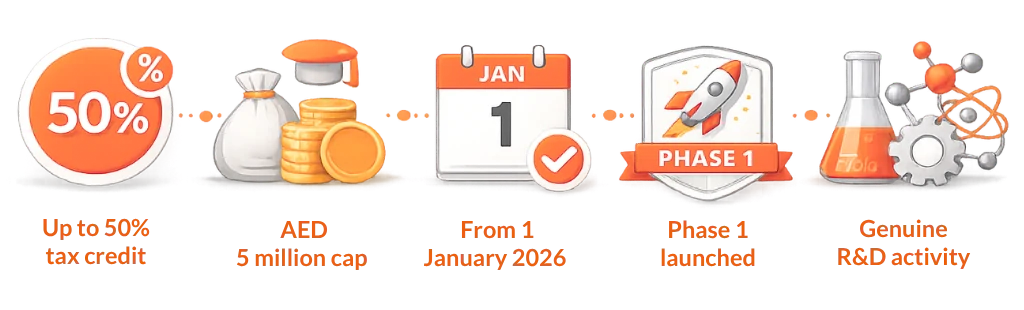
The UAE has launched Phase 1 of its R&D Tax Incentives Programme. Businesses may benefit from a non-refundable R&D tax credit of up to 50% on qualifying expenditure, capped at AED 5 million.
.webp)
Key Takeaways
- The UAE has launched Phase 1 of its R&D Tax Incentives Programme
- Businesses may benefit from a non refundable R&D tax credit of up to 50%
- Qualifying expenditure is capped at AED 5 million
- The regime is expected to align with OECD Frascati Manual principles
- Some practical details are still developing
- Early review can help businesses prepare before more guidance follows
What the UAE R&D tax credit is
The UAE has announced Phase 1 of its Research and Development Tax Incentives Programme as part of a wider push to support innovation, investment, and long-term economic growth.
Under this first phase, businesses may be able to benefit from a non refundable R&D tax credit of up to 50% on qualifying expenditure, with eligible spend capped at AED 5 million.
The early structure of the incentive is meant to give businesses meaningful support for genuine R&D activity, while giving the Ministry of Finance time to monitor uptake and shape future phases of the programme.
In simple terms, this means businesses doing real research and development work in the UAE should start paying attention now.
What is confirmed so far
A few key points are already clear.
The first is that the UAE has officially launched Phase 1 of the programme. This is no longer just a policy idea. It is now something businesses should review seriously.
The second is the value of the incentive. The announced credit can reach up to 50% of qualifying expenditure, with a cap of AED 5 million.
The third is the broad direction of the rules. The regime is expected to follow OECD Frascati Manual principles. That matters since it points to a framework focused on genuine scientific or technological work, rather than ordinary business activity.
The credits are expected to begin from 1 January 2026. That makes early preparation even more useful for businesses that may already be carrying out relevant work.
Who may want to review this
This is worth a closer look if your business is doing more than routine work.
You may want to review your position if your team is building new products, improving technical systems, solving engineering challenges, testing new methods, or working through scientific or technological uncertainty.
In many businesses, this type of work does not always get labelled as R&D internally. It may sit inside operations, engineering, product, technology, manufacturing, or process improvement teams. That is why early review matters.
A business does not need to call itself an innovation company to have potentially relevant activity.
What is still unclear
This is where businesses need to be careful.
Public updates have confirmed the existence of the incentive and its top-level structure. Still, some practical details are not fully clear yet.
There is still limited public detail on which costs may qualify under the UAE regime and how the relief will work in practice. That means businesses should avoid making assumptions too early.
For now, the smart move is not to guess. It is to identify the work your business is doing, gather the right internal information, and get the right support before taking the next step.
That gives you a stronger starting point once more guidance is released.
What businesses should do now
This is a good time to take stock of your current and recent projects.
Start by identifying any work that may involve research, development, technical improvement, or scientific progress. Then look at the teams involved, the costs connected to that work, and the records your business already has.
A simple first review can help answer a few useful questions:
Are we doing work that may fall within the intended scope?
Do we have the right internal description of that work?
Can we support it with clear records if needed later?
Are there gaps we should fix now rather than later?
The businesses that prepare early are usually in a better position once more detail is published.
How Tax Star can support you
The UAE R&D tax credit is a major update, and it is already creating questions for businesses that invest in innovation.
If your business may be carrying out relevant R&D activity, contact Tax Star to start the conversation. We can help you understand the next step and connect you with the right specialist support for a deeper review.