
UAE e-invoicing deadline extended: what this means for businesses now
On 10 May 2026, the Ministry of Finance announced targeted amendments to the decisions governing the UAE e-invoicing system.
The biggest update is the extension of the deadline to appoint an Accredited Service Provider, or ASP.
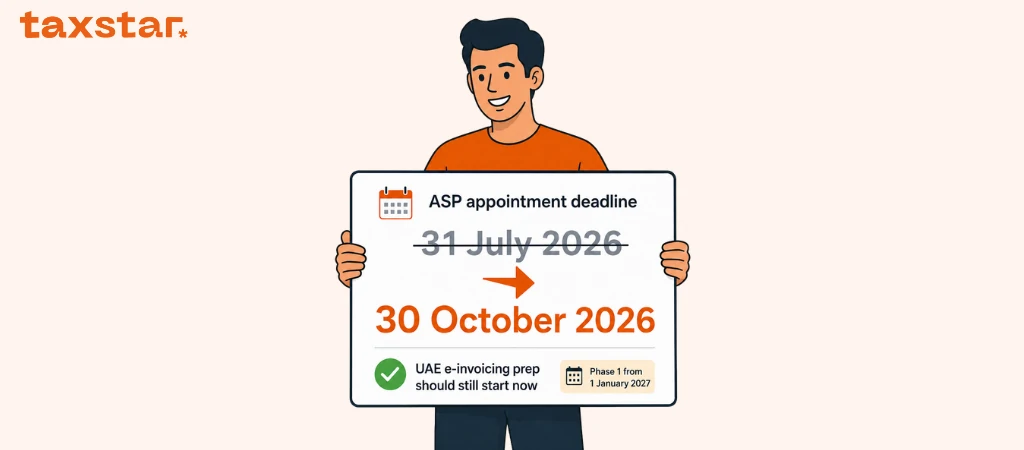
For persons subject to the e-invoicing system with annual revenues above AED 50 million, the ASP appointment deadline has moved from 31 July 2026 to 30 October 2026.
That gives first phase businesses more time to compare providers, review systems, check pricing, and prepare properly.
But here’s the part that matters most.
The mandatory implementation date has not moved.
Businesses with annual revenues above AED 50 million still need to fully implement the UAE e-invoicing system by 1 January 2027.
What changed in the latest UAE e-invoicing update
The main update is the deadline for appointing an Accredited Service Provider, or ASP.
Businesses now have until 30 October 2026 to appoint an ASP. The earlier reported date was in 31 July 2026.
This matters since the ASP is a key part of the UAE e-invoicing process. Businesses will still raise invoices through their ERP, accounting software, billing tool, or invoicing system. But the invoice data must pass through the appointed ASP as part of the exchange and reporting process.
So this deadline is not just about picking a vendor.
It is about choosing the provider your finance process will depend on for electronic invoice exchange, confirmations, technical checks, and connection to the wider UAE e-invoicing model.
For more details, you can visit UAE e-invoicing timeline.
What did not change
The wider UAE e-invoicing rollout still moves ahead.
The first mandatory phase starts from 1 January 2027 for businesses with revenue equal to or above AED 50 million. Businesses below that threshold follow later in 2027, and Government Entities have their own go-live date in 2027.
The pilot programme and voluntary implementation start from 1 July 2026.
So the extension only gives more time for the ASP appointment step. It does not mean businesses should wait until October to begin readiness work.
That would be risky.
By October, you do not want to be asking basic questions like:
- Which invoices are in scope?
- Is our customer data complete?
- Can our ERP send structured e-invoice data?
- Who owns errors after an invoice fails?
- Who is reviewing confirmation messages?
Those questions need work long before onboarding.
Why the ASP deadline was extended
The Ministry said the extension came after a review of market readiness and feedback from the business sector.
The feedback pointed to two main needs:
- broader technical options
- more competitive pricing
That makes sense.
Choosing an ASP is not a small vendor decision. It affects how your invoices are exchanged, checked, reported, and tracked.
A rushed ASP decision can create problems later. A better selection window gives businesses more room to compare providers properly and choose one that fits their systems, invoice volume, support needs, and budget.
The Ministry said 32 Service Providers have already been approved, with more providers in the final stages of accreditation.
That should give businesses more choice as the market develops.
Why the extension matters for finance teams
Finance teams are right in the middle of this change.
UAE e-invoicing is not only a technology project. It affects invoice fields, customer records, supplier records, VAT treatment, credit notes, approvals, and how teams deal with rejected invoices.
A PDF invoice is built for people to read. A UAE e-invoice is issued, transmitted, and received in a structured format that systems can process automatically.
That means your invoice data must be clean before it moves.
If your PDF looks fine but the structured data behind it is incomplete, you can still face issues. Missing buyer details, wrong identifiers, totals mismatch, weak tax category logic, and unclear credit note handling can all create problems once testing starts.
This is where the extra time helps.
It gives your finance team a chance to fix the source data now, not during go-live pressure.
Why ASP selection should not be rushed
Choosing an ASP is one of the most practical decisions your business will make in this process.
The provider should fit your systems, invoice volume, support needs, security expectations, and reporting workflow. It should be able to work with your ERP or accounting software and support both sending and receiving electronic invoices.
When comparing providers, look at:
- UAE accreditation status
- Peppol experience
- integration options with your current systems
- data handling and security controls
- support response times
- service levels
- pricing structure
- ability to scale as invoice volumes grow
A late ASP decision can slow everything after it.
If you wait too long, your team may have less time for testing, issue fixing, staff training, and workflow changes. So, yes, the deadline moved. But the best providers and the best implementation slots may get busy as more businesses start moving.
What businesses should prepare before appointing an ASP
Before selecting an ASP, your team should already know what it needs.
Start with your invoice process.
Where do invoices come from? ERP, accounting software, POS, billing software, spreadsheets, or several systems at once?
Then look at your invoice types.
Do you issue standard tax invoices, commercial invoices, credit notes, staged invoices, recurring invoices, or special VAT scenarios?
Next, check your data.
Your customer and supplier records should include the fields needed for structured e-invoice data. This includes names, addresses, identifiers, tax details, and other invoice fields that may be needed during exchange and reporting.
Then review your VAT setup.
Tax categories, line values, discounts, totals, AED values, and credit note logic need to work inside the data record, not just in the visual invoice.
For a wider simple breakdown, you can visit UAE e-invoicing Hub.
What the five-corner model means in practice
The UAE model uses a five-corner setup.
In simple terms, the invoice journey includes the supplier, the supplier’s ASP, the buyer’s ASP, the buyer, and the FTA.
This means your invoice is not just sent from your email to the customer.
The supplier sends invoice data to its ASP. The ASP validates and converts the invoice into the UAE XML format where needed. The invoice is sent to the buyer’s ASP. Tax data is reported to the FTA. Confirmation messages move back through the process.
For finance teams, this changes the meaning of “invoice sent.”
Sent is not always done.
You need to track whether the invoice passed checks, whether it reached the buyer side, whether tax data reporting worked, and whether confirmation messages came back.
That is why testing matters so much.
What to do now
Here’s what I think businesses should do with the extra time.
Do not start with software demos only. Start with your real invoice data and your real process.
Use the next few months to:
- confirm which phase your business falls into
- review your invoice types and transaction scenarios
- clean customer and supplier master data
- check whether your ERP or accounting software can support structured e-invoice data
- compare ASPs based on integration, support, security, and pricing
- test invoice workflows using real examples
- train finance and operations teams on errors, confirmations, and issue handling
The best use of this extension is simple.
Turn it into preparation time, not waiting time.
If you want help turning these UAE e-invoicing updates into a clean workflow your team can follow, contact Tax Star now for a free consultation.
FAQs
1) What is the new UAE e-invoicing ASP deadline?
The new ASP appointment deadline is 30 October 2026 for persons subject to the e-invoicing system with annual revenues above AED 50 million.
2) What was the previous ASP deadline?
The previous ASP appointment deadline was 31 July 2026.
3) Did the UAE e-invoicing go-live date change?
No. The mandatory implementation date for businesses above AED 50 million remains 1 January 2027.
4) Who does the deadline extension apply to?
It applies to persons subject to the UAE e-invoicing system whose annual revenues exceed AED 50 million.
5) Why was the ASP deadline extended?
The extension followed a review of market readiness and business feedback around the need for broader technical options and more competitive pricing.
6) How many Service Providers have been approved?
The Ministry said 32 Service Providers have already been approved, with more providers in the final stages of accreditation.
7) Should businesses wait until October to start?
No. The extra time should be used for ASP comparison, system checks, data cleanup, testing, and staff training.

.webp)
.webp)
.webp)