
UAE e-invoicing updates: what changed and what finance teams should do next
.webp)
On 23 February 2026, the UAE government published the UAE Electronic Invoicing Guidelines (Version 1.0).
This guidance sits alongside Ministerial Decision No. 243 of 2025 and Ministerial Decision No. 244 of 2025, which set the structure and rollout approach for the Electronic Invoicing System.
If you have been following UAE e-invoicing for a while, you know the hardest part is not the concept. It is the moving pieces. Dates, scope, providers, data rules, and what happens when something fails at the worst possible time.
These recent updates bring more clarity. They also make the action list more obvious. So in this blog, we will keep it practical. What changed, what it means for your day to day invoicing flow, and what to do next.
1) The big change: clearer rules and less guesswork
The most useful shift in the recent UAE e-invoicing updates is that the rules now read more like a real operating model.
You can see:
- how the system is meant to work in practice
- what role the Accredited Service Provider (ASP) plays
- what “structured e-invoice data” actually means for your invoice fields
- how the rollout happens in phases, not all at once
- what penalties sit behind missed steps
So if you were waiting for something more concrete than “it is coming,” this is the point where planning becomes a real project.
2) Pilot and e-invoicing go live dates you can plan around
The rollout is structured in three clear stages, plus a Pilot Programme.
Pilot Programme means a selected group tests the system under Ministry and Authority supervision. Participation is by invitation and written agreement.
Pilot start: 1 July 2026
Voluntary start: 1 July 2026
Then the mandatory phases kick in, based on revenue and entity type.
Go live dates and deadlines (phased):
- Revenue equal to or above AED 50,000,000
- Appoint an ASP by 31 July 2026
- Implement e-invoicing by 1 January 2027
- Revenue below AED 50,000,000
- Appoint an ASP by 31 March 2027
- Implement e-invoicing by 1 July 2027
- Government entities
- Appoint an ASP by 31 March 2027
- Implement e-invoicing by 1 October 2027
If you want the full view of these dates in one place, check UAE E-invoicing Timeline.
3) Scope updates that matter for real workflows
One of the biggest practical questions has been scope.
What transactions are actually in, and what gets extra time.
A key update here is the treatment of VAT groups.
Transactions between members of the same VAT group are still in scope. They are not excluded just because they are intra group.
Yet there is a temporary grace period for VAT group transactions.
What the grace period means in plain language:
- Intra group transactions inside a VAT group get extra time
- The grace period lasts 24 months starting 1 January 2027
- During that period, e-invoicing obligations do not need to be applied to those intra group transactions
- Once the grace period ends, the requirements apply in full for VAT group transactions too
So if you manage a group structure, this changes your sequencing.
You still plan for group invoicing, just not as your first battle.
4) Structured e-invoice data: what the updates push teams to fix
This is where most teams either feel calm or feel stuck.
A PDF invoice is readable.
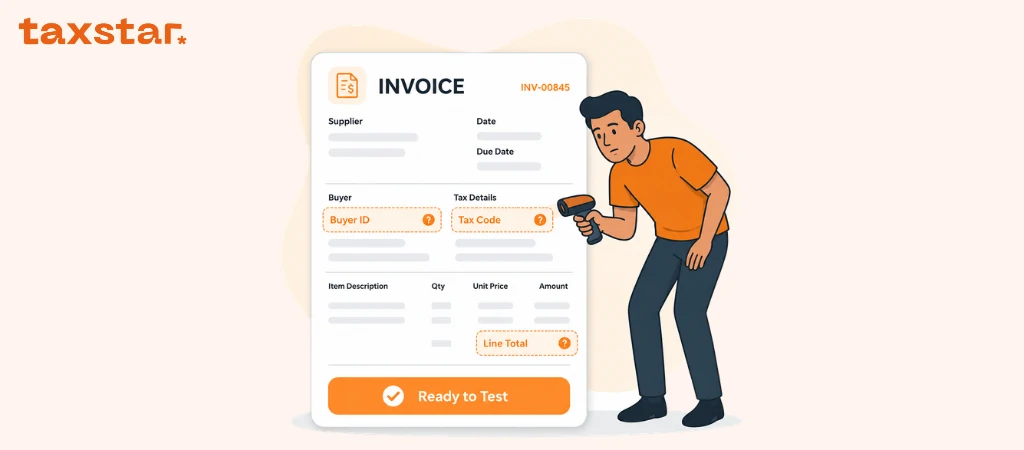
UAE e-invoicing is built around structured e-invoice data, meaning invoice details exist as fields that systems can validate and process automatically.
This is why the mandatory fields reference matters. It makes the work more concrete.
Instead of debating concepts, your team can ask:
Do we store these values cleanly in our system?
Typical field areas your team will end up checking:
- seller details
- buyer details
- invoice identifiers and dates
- line items
- totals and VAT breakdown
- credit note links and correction references, where relevant
This is also why you will hear PINT AE mentioned. It is the billing specification that shapes invoice contents based on document type and scenario. You do not need to memorise it. You do need a mapping plan so your system fields align with the required structure.
5) Accredited Service Provider updates and what to check before signing
The UAE model relies on Accredited Service Providers (ASPs). Both issuers and recipients meet key obligations through appointing an ASP.
Recent updates also clarify how the provider ecosystem is governed.
A few points that matter for businesses:
- a service provider can only offer e-invoicing services in the UAE once accredited
- a Central Register is maintained with the list of accredited providers
- there is a formal path that includes pre approval and then full accreditation
- providers can be delisted if accreditation is terminated
So your selection process is not only about features.
It is about readiness, accreditation status, and operational fit.
6) E-invoice penalties UAE teams should plan for
The updates are not only guidance and timelines. UAE e-invoicing penalties are now clear too, and they link directly to common failure points.
Here are examples of what the penalties framework targets:
- delay in implementing e-invoicing, including delay in appointing an ASP
- failure to issue and transmit an electronic invoice through the system within the required timeline
- failure to issue and transmit an electronic credit note within the required timeline
- failure to notify the Authority of a system failure within the required timeline
- failure to notify the appointed ASP of changes to registered data within the required timeline
The practical takeaway is simple.
Penalties are shaped around missed deadlines and broken process steps, not around “your PDF layout looks wrong.”
So your best defence is a clean workflow, clear ownership, and a way to catch problems before invoices leave your system.
7) What to do now
If you want a short action list that actually helps, here is the sequence we see work best:
- Confirm your phase
Check where you sit based on revenue and whether you are a government entity. - List your invoice scenarios
Standard invoices, discounts, mixed VAT treatment, credit notes, recurring VAT group charges, exports. - Check your structured e-invoice data readiness
Look at master data quality, buyer identifiers, VAT tagging, totals logic, and invoice numbering. - Build an ASP selection checklist
Accreditation status, onboarding steps, validation support, error handling, and who owns fixes. - Create a simple failure plan
Who handles validation errors. How they get reported. What happens at 4pm on a Friday. How the resend loop works. - Start testing with real invoices early
Not one perfect invoice. Real invoice patterns that match your month end life.
If you want help turning these UAE e-invoicing updates into a clean workflow your team can follow, contact us now for a free consultation.
FAQs
1) What are the most important UAE e-invoicing updates right now?
Clearer phased go live dates, a defined Pilot Programme start, VAT group grace period rules, and published penalties for missed steps.
2) When does the Pilot Programme start?
The Pilot Programme starts on 1 July 2026.
3) What are the e-invoicing go live dates for businesses?
Mandatory go live dates start from 1 January 2027 for businesses with revenue equal to or above AED 50,000,000, then 1 July 2027 for businesses below that threshold.
4) Do VAT group intra group transactions need e-invoicing from day one?
They are in scope, yet there is a 24 month grace period starting 1 January 2027 for intra group VAT group transactions.
5) Do I need an Accredited Service Provider (ASP)?
Yes, key obligations for issuers and recipients are fulfilled through appointing an Accredited Service Provider (ASP).
6) What does structured e-invoice data mean?
It means invoice details exist as clean data fields that systems can validate and process automatically, not only as a PDF document.
7) What triggers e-invoice penalties UAE teams should worry about most?
Late ASP appointment, missed invoice transmission deadlines, missed credit note transmission deadlines, late system failure notifications, and late updates to registered data with the ASP.
For more info you can visit UAE E-invoicing Hub.

.webp)
.webp)