
What counts as an e-invoice in the UAE and what does not

Most finance teams feel confident at the start. You already send invoices by email. They look clean. Customers pay. Life is fine.
Then UAE e-invoicing comes up, and the conversation changes fast. Suddenly, it is not about “sending an invoice” anymore. It is about what the invoice is, at a data level.
This blog clears up the basics in plain language. What counts as an e-invoice UAE. What does not. Plus the quickest way to check where your current process sits.
The official definition is tighter than most people expect
The UAE definition of an Electronic Invoice is not “any invoice sent electronically.” It is an invoice issued, transmitted, and received in a structured electronic format that supports automatic and electronic processing.
There is one extra detail that matters in practice. The same definition is used in the UAE mandatory fields reference, and it ties the invoice directly to the Electronic Invoicing System.
So if someone asks you “what counts as an e-invoice UAE,” you can use this simple test:
If it is not structured data that can be processed automatically through the system, it is not the thing the UAE framework is talking about.
If you want the full requirements page your team can share internally, refer to UAE E-invoice Requirenments (place it where you naturally need it in your workflow).
What “structured e-invoice data” means in real finance terms
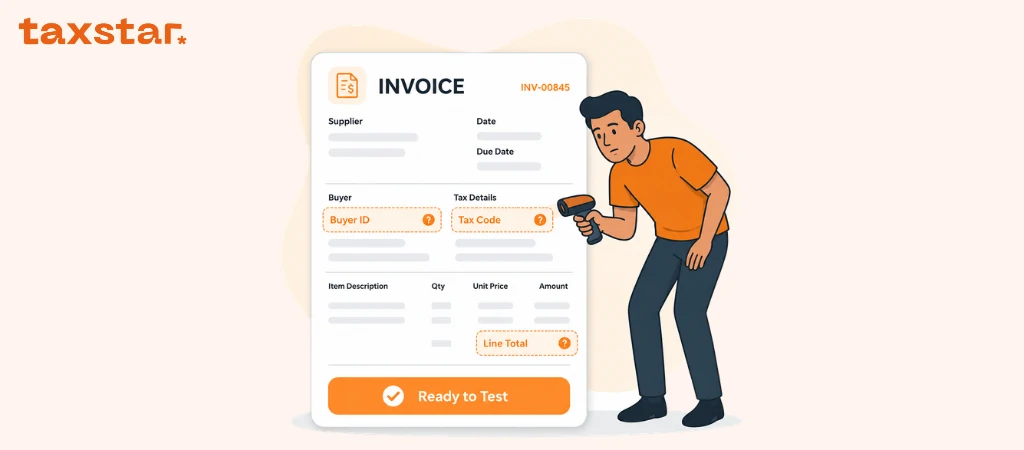
Structured e-invoice data just means your invoice exists as fields, not only as a document.
Think invoice number, invoice date, buyer details, seller details, line items, totals, and VAT breakdown. These are not “typed text on a PDF.” They are real data points in a system.
The UAE mandatory fields guide spells out that Electronic Invoices follow a structured approach, and it includes a glossary definition plus a full list of mandatory fields.
If you want a quick feel for what the “fields” look like, the same guide lists core items like invoice number and invoice date, then expands into buyer and seller details and totals.
This is where pdf vs e-invoice UAE becomes a real gap. A PDF can show the numbers. Structured e-invoice data holds the numbers in a way systems can validate.
The format question: why XML keeps coming up
A lot of people get stuck on formats and forget the bigger point.
Here is the practical version:
- Your internal systems can store invoice data in many ways.
- The UAE exchange format for Electronic Invoices is XML.
The UAE guidelines state that Electronic Invoices are issued, transmitted, and received in XML format.
The guidelines also explain what happens in the flow. A supplier can submit invoice data to its ASP in an agreed format, then the ASP validates it and converts it into the UAE standard Electronic Invoice in XML when needed.
So if your team is searching “UAE e-invoice XML,” the answer is basically this:
You do not build XML manually in most cases. You make sure your invoice data is clean and structured, then your ASP handles the conversion and exchange.
What counts vs what does not: a simple way to explain it internally
This is the section most teams end up copying into an internal email.
What counts as an e-invoice in the UAE
It counts when the invoice is:
- Structured e-invoice data (fields, not just a layout)
- Issued, transmitted, and received through the Electronic Invoicing System in a way that supports automatic processing
- Exchanged through the model that uses service providers as part of the process
What does not count (common examples)
These are still “digital,” yet they are not structured e-invoice data:
- PDF invoices sent by email
- Word invoices
- Scanned invoice images
That “before vs after” shift is captured clearly in the UAE e-invoice master notes too: unstructured documents like PDF, Word, or scans sit on one side, and structured formats sit on the other.
If you want to keep this super simple for non finance stakeholders:
A PDF is a readable output. The e-invoice is the data message. Sending a PDF once e-invoicing is mandatory will not meet the requirement, and missed or non-compliant invoices can lead to UAE e-invoicing penalties.
Where the Accredited Service Provider (ASP) fits
People hear “Accredited Service Provider” and think it is only a tech vendor.
In the UAE framework, the ASP is part of how invoice data moves and gets checked.
The UAE guidelines describe a 5 corner model with the supplier, the supplier’s ASP, the buyer’s ASP, the buyer, and the Federal Tax Authority.
Ministerial Decision No. 243 of 2025 also makes it clear that issuers and recipients fulfil their obligations through appointing an Accredited Service Provider.
If your team is trying to picture the “real life” workflow, this is the easiest way:
- Your system creates invoice data
- Your ASP validates and converts it into the UAE standard XML where needed
- UAE e-Invoicing Guidelines
- The invoice is transmitted via the model to the buyer’s side, with tax data reporting happening in parallel in the flow
- UAE e-Invoicing Guidelines
That is why e-invoicing prep is not just “IT will handle it.” Finance still owns the data quality that feeds the message.
Human readable invoice vs compliant invoice: yes, both show up
A big worry is, “Will my team still have something readable?”
The UAE guidelines include a human readable version of a sample Electronic Tax Invoice.
At the same time, the guidelines are clear that the Electronic Invoice itself is XML, and it will not feature a QR code or barcode.
So the calm way to explain this internally is:
- The compliant layer is the structured e-invoice data message.
- The readable layer is a view of that same invoice for people.
Your preparation work sits in the structured layer. That is where validation checks hit first.
What to do now
If you want a simple sequence your finance team can act on this week:
- Write down your real invoice scenarios (standard invoices, discounts, credit notes, mixed VAT cases)
- Check if your invoice data sits as clean fields in your system, not free text in templates
- Compare your current invoice fields to the UAE mandatory fields list and spot gaps
- Decide who owns fixes when validation issues show up (finance, ops, systems, or shared)
To help in your planning, check our UAE E-invoicing Hub for more information about UAE e-invoicing.
If you want help confirming what counts in your current setup and where the gaps are before testing starts, book a Tax Star book a free consultaion call with our team.
FAQs
1) Is a PDF an e-invoice in the UAE?
No. A PDF is a document. The UAE definition focuses on a structured electronic format that supports automatic processing.
2) What counts as an e-invoice UAE, in one line?
An invoice issued, transmitted, and received as structured electronic data that enables automatic and electronic processing through the system.
3) What is structured e-invoice data?
Invoice details stored as data fields that systems can read and validate, based on the UAE requirements and mandatory fields reference.
4) What format is used for UAE Electronic Invoices?
The guidelines state Electronic Invoices are issued, transmitted, and received in XML format.
5) Do I need an Accredited Service Provider (ASP)?
The framework relies on ASPs, and the obligations are fulfilled through appointing an Accredited Service Provider.
6) Can an ASP convert my invoice data into the UAE standard format?
Yes. The guidelines describe that the ASP validates invoice data and converts it into the UAE standard Electronic Invoice in XML when needed.
7) Is there a human readable version of an Electronic Invoice?
The UAE guidelines include a human readable version of a sample Electronic Tax Invoice.
8) Where do mandatory fields fit into compliance?
The Electronic Invoice must contain the data fields prescribed by the Ministry, and the mandatory fields document provides the list to work from.

.webp)
.webp)