
XML or JSON for UAE e-invoicing: what businesses need to prepare

A lot of businesses start this topic with the wrong question.
They ask, “Do we need XML or JSON?”
That sounds logical. Yet for most finance teams, the bigger issue is not the format itself. It is whether your invoice data is clean enough to move through the UAE e-invoicing flow without creating problems later.
So yes, the format matters. Still, it matters in a very specific way.
This blog breaks that down in plain language. What the UAE model points to, where JSON still fits in real business setups, and what your team should prepare now.
Start with the short answer: the UAE e-invoice itself is XML
If your team wants the cleanest answer first, here it is.
The UAE Electronic Invoice is built around XML as the formal invoice format.
That means when people talk about the actual e-invoice moving through the exchange model, XML is the format at the centre of that process. So if someone inside the business says, “We only need a PDF or a simple export,” that is where confusion starts.
This is why the better question is not “can our system print invoices?”
It is “can our system produce structured e-invoice data that can become the UAE compliant invoice message?”
That difference matters a lot. A business can still have readable invoice copies for people. Yet the real compliance layer sits in the structured data, not in the document layout.
So where does JSON fit?
This is where teams get mixed up, and honestly, it makes sense.
Many systems today use JSON in APIs, integrations, and internal data handoffs. So when finance teams hear “structured data,” they naturally wonder if JSON is enough.
In practice, JSON can still matter inside your business setup.
Your ERP, billing tool, commerce platform, or internal integration may store or send invoice data in JSON during upstream steps. Your team may never even see it, yet your tech team probably does. That is normal.
The key point is this:
JSON may be part of the internal handoff. XML is what matters for the UAE e-invoice itself.
So businesses do not need to panic if their systems talk in JSON behind the scenes. What they need to confirm is whether that data can be mapped cleanly into the UAE e-invoice structure through the Accredited Service Provider (ASP) flow.
That is why this is really a readiness question, not a format argument.
For more details, you can visit UAE e-invoicing requirements.
The real prep work is in your data, not the file label
This is the part businesses often skip.
Teams spend too much time asking what file extension sits at the end. XML. JSON. CSV. API payload. Export file.
Meanwhile, the real blockers sit upstream in the invoice data itself.
If your data is weak, the format will not save you.
That shows up in very practical ways:
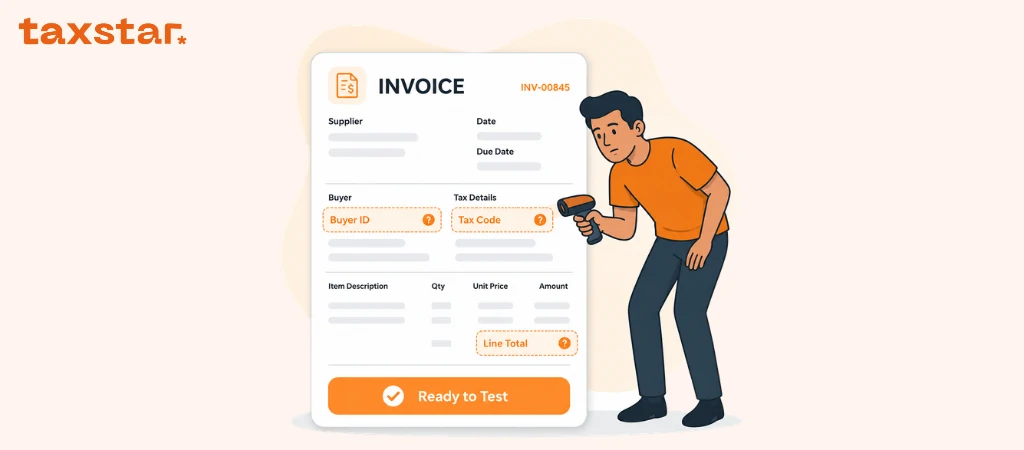
- buyer identifiers are missing or inconsistent
- seller details are stored differently across systems
- addresses are dumped into free text fields
- item and service records are not standardised
- VAT treatment is applied manually instead of through rules
- totals and VAT totals do not reconcile the same way every time
- credit note links are unclear or hard to trace
This is why structured e-invoice data matters more than the XML versus JSON debate. The UAE flow expects data that systems can validate, not just data that looks fine on screen.
So the prep work should start with source data quality. Once that is clean, format mapping becomes much easier.
What businesses should ask their ASP and system team
This is where finance, operations, and systems need to get in the same room.
You do not need a long technical workshop. You just need the right questions.
A few good ones:
1) What format does our system produce today?
Do we already hold invoice data in structured fields, or are we still relying on templates and manual edits?
2) Are we using JSON anywhere upstream?
If yes, where is it used? Internal API? Middleware? ERP connector? Custom integration?
3) How does that data become the final UAE e-invoice?
Who maps it? The ERP team? Middleware partner? ASP? Shared ownership?
4) What happens if required fields are missing?
Do we get a validation error early, or do we only notice during testing?
5) Who owns changes to source data?
This is a big one. If finance spots a field issue, who fixes it and where?
6) How are credit notes and corrections handled?
You do not want to discover this during month end.
7) Are we testing with real invoices?
Not one perfect sample. Real invoices with discounts, mixed VAT treatment, and edge cases.
These questions shift the conversation from “format theory” into “actual readiness.”
Why finance teams should not wait for the final integration stage
A common mistake is thinking this becomes real only when the integration starts.
That is too late.
By then, you are already discovering whether your customer records are incomplete, whether your VAT logic is inconsistent, and whether one business unit stores invoice data differently from another.
Format questions tend to get solved by vendors and technical teams.
Data quality issues end up back with the business.
That is why finance teams should get involved early. Not to build XML. Not to debate APIs. Just to make sure invoice data is accurate, consistent, and owned properly.
If that part is solid, your ASP and systems team have something they can work with. If it is messy, the project slows down no matter what format your platform uses. A slow project can also mean missed deadlines, and missed deadlines can lead to UAE e-invoicing penalties.
What to do now
If your team is stuck on the XML or JSON question, use this sequence:
- Confirm what your system stores today
Look at actual invoice fields, not just the PDF output.
- Identify where JSON is used internally
This helps your team understand the upstream flow without confusing it with the final UAE e-invoice format.
- Check how your ASP handles mapping
You want a clear answer on how source data becomes the compliant invoice structure.
- Clean source data before testing
Focus on identifiers, addresses, tax treatment, numbering rules, and totals logic.
- Test with real invoice scenarios
Use invoices that reflect daily work, not one ideal example.
For more details, you can visit UAE e-invoicing hub.
If you want help turning these UAE e-invoicing requirements into a clean workflow your team can follow, contact us now for a free consultation.
FAQs
1) Is the UAE e-invoice format XML or JSON?
The formal UAE e-invoice is built around XML. JSON can still appear in internal system flows or upstream integrations.
2) Can my ERP use JSON and still support UAE e-invoicing?
Yes, it can. The key is whether that data can be mapped properly into the final UAE compliant e-invoice structure.
3) Does finance need to understand XML?
Not in a technical way. Finance needs to focus on clean source data, required fields, totals, VAT logic, and ownership.
4) What matters more, XML or structured e-invoice data?
Structured e-invoice data matters more. If the source data is weak, the output format will not fix the problem.
5) What should I ask my ASP about JSON?
Ask where JSON is used, who maps it into the final e-invoice structure, and how validation errors are handled.
6) Can we keep using PDFs too?
A readable PDF can still exist for people. The core compliance layer sits in the structured e-invoice data.
7) What usually causes problems first?
Missing fields, weak master data, inconsistent identifiers, VAT treatment issues, and totals that do not reconcile cleanly.
8) What should businesses prepare first?
Start with the data. Clean the fields, lock ownership, confirm the mapping flow, then test real invoice scenarios.

.webp)
.webp)