
UAE e-invoicing rollout phases explained in plain language
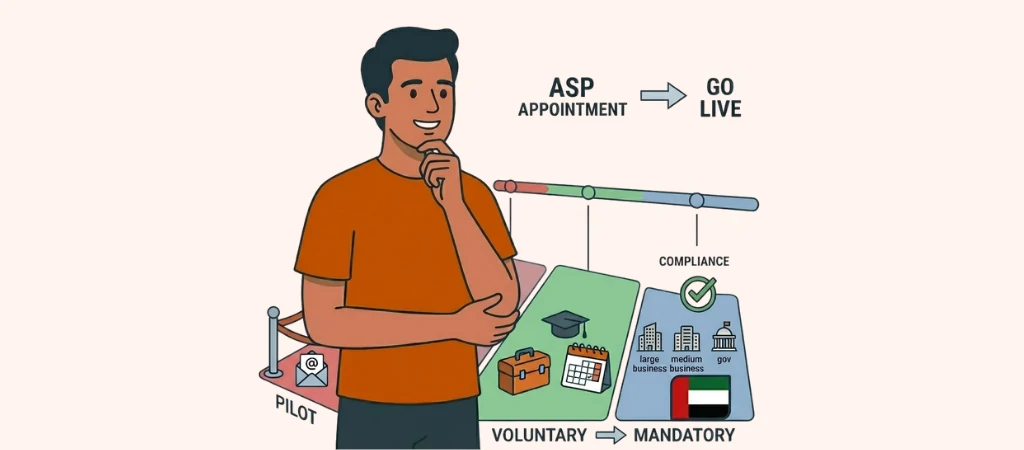
A lot of businesses hear the same three words again and again.
Pilot. Voluntary. Mandatory.
They sound simple at first. Then the questions start.
Does pilot mean everyone can start?
Is voluntary the same as early go live?
Does mandatory hit every business at once?
Where does the ASP fit into all this?
That is where confusion builds up.
This blog is here to clear that up. Not by throwing dates at you one after another. Just by explaining what each rollout phase means, why the UAE is doing it this way, and what businesses should take from each stage.
The rollout is staged on purpose
The UAE e-invoicing system is not launching as a one day switch for the whole market.
It is being rolled out in stages.
That matters because businesses are not all in the same place. Some have strong systems already. Some still rely on manual invoice handling. Some need time to clean data, connect with an Accredited Service Provider, and test how invoices move through the system.
So the phased rollout is really a transition plan.
It gives room for testing first, then early adoption, then mandatory implementation by segment.
In simple terms, the structure looks like this:
- pilot phase
- voluntary phase
- mandatory phase
That is the big picture. Everything else sits under those three stages.
The pilot phase is for supervised testing
The pilot phase is the first live step, but it is not a public launch.
It is a controlled phase where selected businesses take part in testing the Electronic Invoicing System under supervision. Those businesses are contacted and included as part of a working group. They do not just click a button and join.
So when people hear “pilot,” they should not think “general availability.”
They should think “supervised live testing with selected participants.”
That matters because many businesses assume the pilot is the stage where everyone starts trying the system. That is not really the role of the pilot. Its role is to test the model in a more controlled way before wider use grows.
For most businesses, the practical takeaway is simple.
You may never be part of the pilot. That does not put you behind. It just means your attention should be on the next stage.
The voluntary phase is where many smart teams will learn fastest
The voluntary phase is where the system becomes much more real for the wider market.
This is the stage where businesses can choose to start early, even before they are forced to do so. That makes it one of the most useful stages in the whole rollout.
Why?
Because it gives teams a chance to learn without waiting for deadline pressure.
This is where businesses can get familiar with:
- how invoice data reaches the ASP
- how structured e-invoice data behaves
- how confirmation messages come back
- where data issues show up
- what needs fixing before go live becomes mandatory
That is why the voluntary phase should not be treated like a side note.
It is really a practice window.
For a lot of businesses, this will be the safest time to test real invoice scenarios, fix issues calmly, and get people used to the new workflow before the final date starts to matter in a bigger way.
For exact dates and more details, you can visit UAE e-invoicing timeline.
The mandatory phase is where the rollout becomes real compliance
This is the stage most businesses care about most.
Mandatory implementation is the point where e-invoicing stops being a “we should prepare” topic and becomes a “we must be ready” topic.
Still, even here, the rollout is not one single deadline for everyone.
It is split into segments.
That is important because the mandatory phase is built to reflect business size and entity type. Bigger businesses move earlier. Smaller businesses follow later. Government Entities have their own path.
So the mandatory phase is not just one date. It is a structured rollout across segments.
That means two things matter:
First, your business needs to know which segment it belongs to.
Second, your business needs to understand that the rollout includes both an ASP appointment deadline and a go live deadline.
That second point gets missed a lot.
Teams often focus only on when they must be live. In practice, the earlier ASP date is what starts the real work.
Why the UAE did not go straight to mandatory for everyone
This is probably the most useful plain language question in the whole topic.
Why not just set one date and make everyone comply from that point?
The answer is simple.
Because e-invoicing is not just a document change. It is a process change.
It affects:
- invoice data structure
- system connections
- buyer and seller identifiers
- reporting flow
- approvals
- error handling
- ongoing monitoring
So a phased rollout gives businesses time to move from theory to practice.
The pilot helps test the model.
The voluntary phase helps businesses learn early.
The mandatory phase pushes the market into full compliance in an organised way.
That makes the rollout easier to manage for both businesses and the system itself.
It also gives businesses time to work through the messy parts, which are usually not the invoice template. They are the data fields, the integrations, and the ownership gaps.
Where businesses usually get confused
This is the part worth watching, especially if your team is only starting to read up on the topic.
A few common mix ups show up again and again.
1) Thinking pilot means public launch
It does not. Pilot is controlled and invitation based.
2) Thinking voluntary means unimportant
It is actually one of the best times to prepare early.
3) Thinking mandatory means one date for everyone
It does not. The rollout is phased by segment.
4) Thinking the main deadline is the only deadline
It is not. The ASP appointment deadline matters too.
5) Thinking rollout phases are only about dates
They are not. They are really about readiness stages.
Once a business sees the rollout through that lens, the whole structure becomes much easier to follow.
What to do now
If you want to use the rollout phases properly, keep it simple:
- understand which phase you are in now
- decide whether voluntary implementation would help your team prepare earlier
- check which segment and deadlines apply to your business
- treat the ASP appointment date as the start of real preparation
- use the time before go live to test, fix data, and set ownership clearly
For more details, you can visit UAE e-invoicing hub.
If you want help turning the rollout phases into a clean plan your team can follow, contact us now for a free consultation.
FAQs
1) What are the UAE e-invoicing rollout phases?
The rollout moves through three stages: pilot, voluntary implementation, and mandatory implementation.
2) Is the pilot phase open to everyone?
No. The pilot is for selected participants that are included and agree to take part.
3) What is the voluntary phase for?
It gives businesses a chance to start early, test the workflow, and fix issues before mandatory implementation applies to them.
4) Does mandatory e-invoicing start on one date for everyone?
No. It is phased by segment, based on revenue and entity type.
5) Why is the rollout phased instead of one single launch?
Because e-invoicing changes data, systems, reporting flow, and internal processes. A phased rollout gives businesses time to prepare properly.
6) What is the difference between the ASP deadline and the go live date?
The ASP deadline is the earlier date by which the provider must be appointed. The go live date is when e-invoicing must be running in practice.
7) Should businesses ignore the voluntary phase if they are not required yet?
That is usually a missed opportunity. The voluntary phase can help teams learn early and reduce pressure later.
8) What is the simplest way to think about the rollout?
Think of it as three stages of readiness: supervised testing, early adoption, then full compliance.

.webp)
.webp)
.webp)