UAE E-Invoicing Guidelines October 2026: 8 Key Updates for Businesses
The Ministry of Finance published Version 2.0 of the UAE Electronic Invoicing Guidelines on 26 October 2026.
For anyone already working on UAE e-invoicing, the useful part is not another overview of the five-corner model. It is the extra detail around real invoice situations.
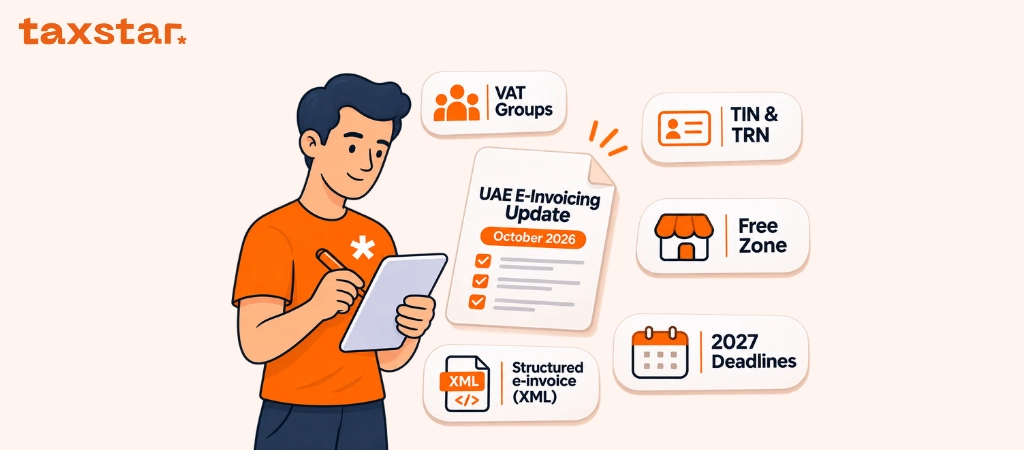
VAT groups. TINs. Customers that are not on Peppol yet. Advance payments. Free Zone transactions. Invoice type codes.
These are the areas where finance teams tend to get stuck once testing starts.
The rollout dates have not changed, but the October guide gives more detail on how these cases should be handled.
Here are the eight updates worth checking.
1. The 2027 dates are still in place
There is no new extension in the October guidelines.
For businesses in the first mandatory phase, the deadline to appoint an Accredited Service Provider was 30 October 2026.
Mandatory e-invoicing for that group begins on 1 January 2027.
Businesses with annual revenue below AED 50 million must appoint an ASP by 31 March 2027 and implement e-invoicing by 1 July 2027.
Government entities have until 31 March 2027 to appoint an ASP, with implementation from 1 October 2027.
There is another rule that new companies need to watch.
A newly established business that falls within the UAE e-invoicing scope must appoint an ASP and complete onboarding before issuing its first invoice.
That means a business set up in 2027 cannot simply look at the main rollout table and assume it has months before it needs to act.
You can see the full rollout in our UAE e-invoicing hub.
2. VAT groups get 24 months for internal transactions
Transactions between members of the same VAT group are still within scope.
The October guidance gives them a 24-month grace period from 1 January 2027.
So if Company A and Company B are members of the same VAT group and Company A invoices Company B, that internal transaction gets the grace period.
Now take the same Company A and have it invoice an external customer.
That invoice follows Company A’s normal e-invoicing timetable.
The grace period is for transactions between members of the same VAT group. It is not a general delay for every company inside the group, and related-party transactions are not automatically treated as VAT-group transactions.
For groups using one ERP across several legal entities, this is something to map properly before testing starts.
3. TIN and TRN usage is much less ambiguous now
The guide gives a direct answer on seller identification.
A UAE TIN is a 10-digit identifier used for e-invoicing. For a business already registered with the FTA, it is the first 10 digits of its TRN.
The VAT TRN is 15 digits.
A VAT-registered seller uses the 15-digit VAT TRN in the Seller VAT Identifier field, IBT-031.
A seller that is not VAT registered uses the 10-digit TIN in the Seller Tax Registration Identifier field, IBT-032.
One common error is entering a Corporate Tax TRN into the Seller VAT Identifier field.
That is not the correct treatment.
A company can be registered for Corporate Tax, have no VAT registration, and still fall within UAE e-invoicing. In that case, the TIN is the relevant seller tax identifier under the PINT-AE rules in the guide.
Businesses that do not already have an FTA tax registration need to register with the FTA and obtain a TIN if they fall within scope.
VAT-group members use their own TINs. They do not use the group representative’s TIN for their own e-invoicing identity.
4. Buyers that have not joined Peppol now have a defined route
This will come up during the phased rollout.
A supplier could be live from January 2027 and still have customers that do not need to implement e-invoicing until July.
Those customers may not have a Peppol Participant Identifier.
Where the buyer is not subject to the UAE e-invoicing framework and has no Participant Identifier, the predefined electronic address is:
0235:9900000098
A regular Tax Invoice, such as a PDF, may still need to go to that buyer alongside the structured e-invoice.
Exports use a different endpoint.
Where the transaction is classified as an export and the receiver is not registered in Peppol, the endpoint is:
0235:9900000099
Those two values are used for different cases.
A good test is to take actual customer records and see whether the accounting system can tell the difference between a UAE buyer that has not joined Peppol yet and an overseas buyer.
If that information is missing today, the customer record needs somewhere to hold it.
5. Invoice type codes need a closer look
A zero VAT amount does not tell you enough on its own.
A supply can be zero-rated, exempt, or outside the scope of VAT. Those treatments are different.
The October guidance gives more detail on invoice type codes.
Invoice Type Code 380 is used for UAE Tax Invoices where VAT applies.
Invoice Type Code 480 is used where the invoice contains supplies that fall exclusively outside the scope of VAT.
Code 480 is not used for zero-rated supplies.
It is not used for exempt supplies either.
That distinction can become a mapping issue if an accounting system treats every “0% VAT” transaction in the same way.
Reverse-charge transactions need the same check.
For UAE e-invoicing, the reverse-charge tax category described in the guide applies to qualifying domestic supplies of certain goods between VAT registrants.
Imports of Concerned Goods and Concerned Services under reverse charge are outside the e-invoicing requirement.
So one ERP tax code called “Reverse Charge” may need more than one treatment once it is mapped to PINT-AE.
And for anyone wondering about product classification:
HSN codes remain optional.
The Ministry says the timing for making them mandatory will be announced later.
6. Advance payments have a much clearer treatment
The guide now gives a simple example.
A business has a contract worth AED 10,000 before VAT.
It receives an advance of AED 1,000.
A tax invoice is issued for that AED 1,000 when the money is received.
Later, the final invoice covers the remaining AED 9,000 before VAT.
The business does not invoice the full AED 10,000 again.
The final e-invoice can refer back to the advance invoice.
The guide goes further where an invoice has several lines.
If the advance relates to one item, it should be allocated to that item.
If it relates to the transaction as a whole, the buyer and seller can agree how to split it across the relevant lines.
The split should match the commercial arrangement and should not change the VAT treatment of the supplies.
Retention has separate guidance.
A business can issue an e-invoice for the amount payable after retention, then issue another e-invoice for the retained amount when the buyer becomes liable to release it.
For construction and project-based businesses, this is worth comparing with the way advances and retention are recorded today.
If the information sits partly in spreadsheets, project software or email, it still has to reach the e-invoice correctly.
7. Free Zone invoices need beneficiary details
The updated guide gives more detail on the Free Zone scenario.
PINT-AE includes a Free Trade Zone flag within the invoice transaction type code.
The Free Zone scenario can apply where the supplier, buyer or beneficiary is a Free Zone entity, or where the supply takes place within or from a Free Zone.
The beneficiary field is the part to pay attention to.
Where the customer is a Free Zone entity, the e-invoice requires beneficiary details.
The beneficiary is the person or entity that uses, consumes or owns what is being supplied.
In many cases, the customer and beneficiary will be the same company.
Say a Free Zone company orders consulting services for its own team. It signs the contract, receives the service and pays the invoice.
The customer and beneficiary are the same legal entity.
The Beneficiary Name and Beneficiary ID can repeat the customer details.
Change the setup slightly.
A Free Zone parent company signs the contract, but the work is delivered to another company in the group.
Now the customer and beneficiary may be different.
The e-invoice needs to show that.
Some businesses already store this information in their ERP. Others only have it in the purchase order or contract.
That is the gap to find.
The Free Trade Zone flag is separate from the VAT category and rate. Both need to be recorded correctly.
8. Your ASP can store invoices, but the legal responsibility stays with you
The October guide gives more detail on storage.
A business can agree with its ASP to store e-invoices, e-credit notes and related data on its behalf.
The legal responsibility still sits with the business.
So it is not enough to ask whether the ASP stores invoices.
Finance teams need to know whether an old e-invoice can actually be retrieved, reproduced in a readable form, and provided to the FTA when requested.
For taxable persons, the standard retention period is five years following the relevant tax period.
For other persons, it is five years from the end of the calendar year in which the document was created.
Real estate records have a seven-year period.
Some audit, dispute and voluntary disclosure cases can extend the retention period.
Before go-live, it should be clear what the ASP stores, what the company stores itself and how records are retrieved later.
Two other points from the October guide
Healthcare and insurance got more detail too.
If a hospital treats an individual patient and the insurer simply pays the patient’s bill under the policy, the insurer does not become the buyer just by making the payment.
The patient remains the recipient of the healthcare supply.
If the insurer receives a separate service in its own capacity, the treatment can be different.
Buyer identification has extra guidance too.
For UAE buyers, the Buyer Identifier field can require the UAE TIN under the applicable PINT-AE rules.
The Buyer Legal Registration Identifier is a separate field.
They are not the same thing.
What I would test now
Use real invoices.
Pick the ones your team already finds awkward.
A Free Zone customer. An advance payment. A credit note. A buyer outside the UAE. A customer that has not joined Peppol. An invoice with zero-rated or out-of-scope lines.
Then check whether the system has enough data to send each one correctly.
Look at:
- TINs and VAT TRNs
- buyer Peppol status
- VAT-group relationships
- invoice type codes
- advance and retention handling
- Free Zone beneficiary details
- storage and retrieval
- failed invoice messages
That test will usually expose missing fields much faster than another clean demo invoice.
Businesses using QuickBooks Online can see how their current setup connects to UAE e-invoicing through the Tax Star QuickBooks integration.
Get your business ready with Tax Star
Tax Star is a UAE Ministry of Finance-accredited ASP.
It connects with accounting and ERP systems, maps invoice data into PINT-AE, exchanges e-invoices through Peppol and handles the required FTA reporting flow.
Get your business ready for UAE e-invoicing with Tax Star. Book a demo to see how it connects with your existing accounting system.
FAQs
What changed in the October 2026 UAE e-invoicing guidelines?
Version 2.0 gives more detail on VAT groups, TINs and TRNs, buyer identification, invoice type codes, advance payments, retention, Free Zone transactions, storage and several transaction scenarios.
Has the UAE e-invoicing deadline moved again?
No. The October guide keeps the current rollout dates. The first mandatory phase begins on 1 January 2027.
Do VAT-group companies need e-invoicing for internal transactions?
Those transactions remain in scope, but there is a 24-month grace period from 1 January 2027 for transactions between members of the same VAT group.
Are HSN codes mandatory?
No. They remain optional. The Ministry says the timing for making them mandatory will be announced later.
Can a business outside VAT registration still fall within e-invoicing?
Yes. UAE e-invoicing scope is not based on VAT registration alone.
What happens if a customer has not joined Peppol?
A predefined buyer electronic address may apply. The correct endpoint depends on the buyer’s status and the transaction type.
Do Free Zone customers need beneficiary details?
Yes. Where the customer is a Free Zone entity, beneficiary details are required. If the customer and beneficiary are the same company, the information can match.
Can an ASP store e-invoices?
Yes, where the business and ASP agree to that arrangement. The business still carries the legal responsibility for record retention.
Disclaimer: This article is based on Version 2.0 of the UAE Electronic Invoicing Guidelines dated 26 October 2026. It is general information and is not tax or legal advice.
Official source: UAE Ministry of Finance, Electronic Invoicing